Organisations want agility. They want engagement. They want people who take responsibility in change. And yet we still often work with models that describe behaviour as if it were a fixed trait.
Profiles, types, colours, styles. They give us language. They give us something to hold on to. But they also suggest something: stability. And that is where tension arises.
Development asks for movement. The fixed profile in a moving world.
Personality models have value in themselves. They help make differences visible. They support conversations about collaboration and role division. But the moment behaviour is too tightly tied to identity, something subtle happens. "That's just who I am." "That doesn't fit my style." What was meant as insight can unintentionally become a limit.
In a world that is constantly changing, a fixed description is not enough. Not because it is wrong, but because it does not tell the whole story.
What motivation research has been showing for years
Mihaly Csikszentmihalyi's flow theory makes clear that engagement does not arise because someone is a certain type. Flow arises when challenge and skill are in balance. Flow is not a trait. Flow arises in the right circumstances.
Edward Deci and Richard Ryan's self-determination theory shows that motivation changes depending on how the environment supports autonomy, competence and relatedness. Daniel Pink builds on this in Drive. Autonomy and mastery are not character traits, but conditions in which energy is released.
Carol Dweck's work shows that development is not locked into aptitude, but is shaped by how someone views learning.
What do all these perspectives have in common? They don't only look at who someone is. They look at when someone grows. The DEaLflow Method connects to this.
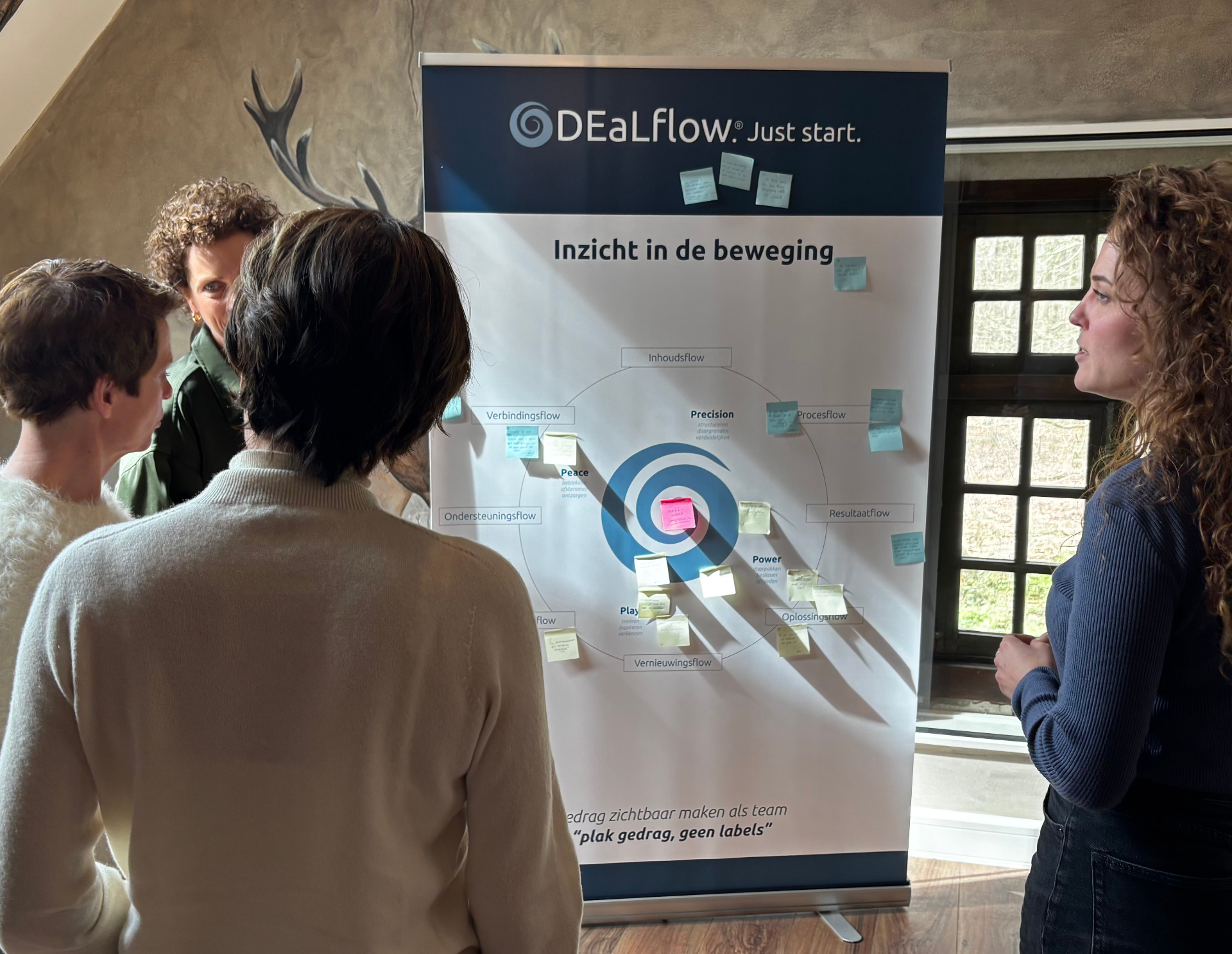
DEaLflow: energy in motion
DEaLflow starts from a dynamic view of people. Behaviour is not seen as a fixed trait, but as movement in relation to context, tension and meaning. The focus is not on who you are. It is on the energy in motion.
Instead of typifying people, DEaLflow examines where energy is released and where it drops away. That makes the model relevant not only for development, but also for selection and personal leadership.
Selection then becomes not a search for the right type, but for the right match between person and environment. Leadership becomes not an attempt to correct behaviour, but to design conditions in which energy can emerge.
The difference that matters
Many models describe behaviour as identity. DEaLflow examines behaviour as movement. The difference looks small. It is fundamental. A label fixes things. Movement opens space.
In a stable world a profile is enough. In a changing world, insight into movement is indispensable.
Why this matters now
Organisations don't need more labels. They need adaptive capacity.
A dynamic view of people:
People are not fixed profiles. They are systems in motion. And those who understand movement, understand development.